Halloween Cowboy Boots Embroidery Design
A Practical Review for Small Business Merch & Branded Patches
As an embroidery designer who’s helped over 200 small businesses launch cohesive, production-ready merchandise—from café aprons to boutique tote bags—I approached the Halloween Cowboy Boots Embroidery Design with a very specific question: Does this design translate reliably from screen to stitched product across real-world business applications? Not just as a fun seasonal graphic, but as a functional, brand-aligned asset for embroidered patches, staff uniforms, caps, and customer-facing merchandise.
First Impression: Playful Rustic Meets Clear Seasonal Intent
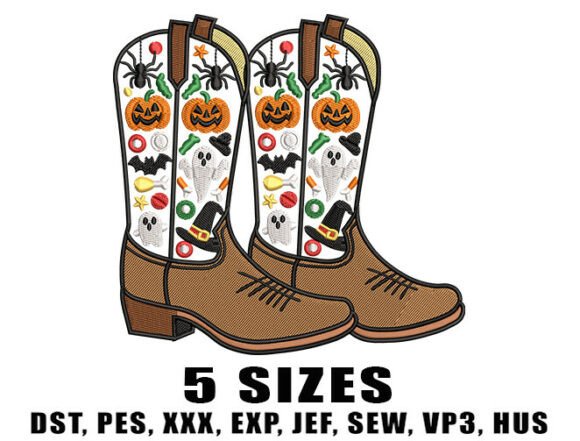
The title alone tells a strong visual story: “Halloween Cowboy Boots.” It signals a confident blend of Americana charm and spooky festivity—no vague silhouettes or generic ghosts here. Based on the description (“stylish cowboy boots decorated with festive Halloween elements like pumpkins and bats”), this isn’t a cluttered collage. It suggests intentional composition: boots as the anchor, with thematic accents placed thoughtfully—not crammed, not competing. That balance is critical for small business use. A playful yet structured aesthetic reads as handmade product without sacrificing professionalism. It feels approachable for a local florist’s October pop-up, bold enough for a pet brand’s limited-run bandana line, and distinctive enough to stand out in an Etsy shop full of generic pumpkin motifs.
Real-World Performance Across Business Touchpoints
The Halloween Cowboy Boots Embroidery Design shines where many seasonal designs falter: versatility with intention. As an embroidered patch, it holds up beautifully when applied to denim jackets, canvas tote bags, or woven labels on handmade soap packaging. Its central boot shape provides natural symmetry for chest placement on work shirts or aprons—ideal for cafés, bakeries, or craft studios wanting staff to wear branded spirit without looking costumed.
In cap embroidery, the vertical orientation works well on front panels (especially mid-crown structured caps), and its moderate width avoids stretching issues common with wide, dense designs. On tote bag design, it scales cleanly to 4–5 inches wide—large enough to read at arm’s length, tight enough to avoid stitch pucker on lightweight cotton canvas. For apron embroidery, it lands perfectly above the pocket or centered on the bib, reinforcing brand identity while keeping utility intact.
It also functions well as a subtle accent: think sleeve embroidery on flannel work shirts, a single boot motif on the hem of a boutique’s reusable produce bag, or even stitched onto kraft paper gift tags for Halloween-themed product bundles. Because it leans into recognizable iconography (boots + pumpkins + bats) rather than intricate scenes, it supports quick visual recognition—key for small business merch that needs to communicate seasonality and personality in under two seconds.
Where to Use With Intention—Not Assumption
Like any quality machine embroidery design, the Halloween Cowboy Boots Embroidery Design demands thoughtful application. Avoid shrinking it below 2.5 inches wide—tiny pumpkins or bat wings may lose definition or become unstable on textured fabric. Cap fronts with heavy curvature (like low-profile unstructured caps) require careful digitizing adjustments; always test on your target blank first.
High stitch density areas—especially around boot stitching or pumpkin stems—can cause puckering on lightweight knits or delicate linens. If you’re embroidering on dark uniforms (e.g., black aprons or navy staff polos), confirm thread color contrast: orange or lime green bats against charcoal thread may disappear without proper underlay or color testing. And never skip stabilizer—especially for commercial embroidery runs. Tear-away works for stable wovens; cut-away is essential for stretchy or loosely woven fabrics like some canvas totes.
Impact on Brand Identity & Customer Trust
This design does more than decorate—it reinforces authenticity. When a local bakery uses the Halloween Cowboy Boots Embroidery Design on staff aprons and seasonal pastry bags, it signals creativity, attention to detail, and seasonal engagement—without leaning into kitsch. Customers connect that consistency across touchpoints (a patch on a barista’s cap, the same motif on a limited-edition cookie tin label) with reliability and care. That builds brand identity quietly but powerfully.
For Etsy sellers and handmade brands, it elevates perceived value. A custom digital embroidery file like this—paired with clean mockups—positions your offerings as professional-grade, not craft-fair casual. Buyers engage longer when they see how the design lives across products. That directly supports conversion, repeat visits, and word-of-mouth sharing.
Essential Embroidery Designer Notes Before You Stitch
- Always test in black and white first—this reveals spacing issues, thin outlines, and potential thread nesting before color complicates diagnosis.
- Verify patch-size viability: Resize to your most common patch dimension (e.g., 2.75” x 2.75”) and inspect clarity of all elements—not just the boots, but the smallest bat wing or pumpkin stem.
- Review thread color contrast on your actual fabric swatches—not just screen previews. Lighting, dye lot variance, and fabric sheen dramatically affect perception.
- Inspect lettering (if included) and spacing between elements. Tight kerning or overlapping shapes won’t resolve cleanly at production scale.
- Confirm hoop size compatibility with your primary machines—especially if using multi-position hoops for large runs.
- Test on real fabric, with your standard stabilizer stack, before approving final files for client production.
- Create a printable mockup for client sign-off—show the Halloween Cowboy Boots Embroidery Design on a realistic tote bag, cap, and apron view. Visual context prevents costly revisions later.
- Compare it beside your existing design assets—does it share consistent line weight, motif scale, and stylistic tone? Consistency strengthens long-term brand identity.
- Confirm commercial licensing before using in client projects, wholesale apparel, or digital resale. Even if labeled “for commercial use,” verify permitted applications (e.g., physical goods only vs. digital templates).
The Halloween Cowboy Boots Embroidery Design isn’t just another seasonal download—it’s a strategic tool. When applied with intention, it helps small businesses own their niche, delight customers authentically, and deliver custom apparel that feels both special and seamless. Just remember: great embroidery starts not with the file, but with how thoughtfully you prepare it for the real world.