Café Table and Chairs Embroidery
A Design That Whispers, Not Shouts
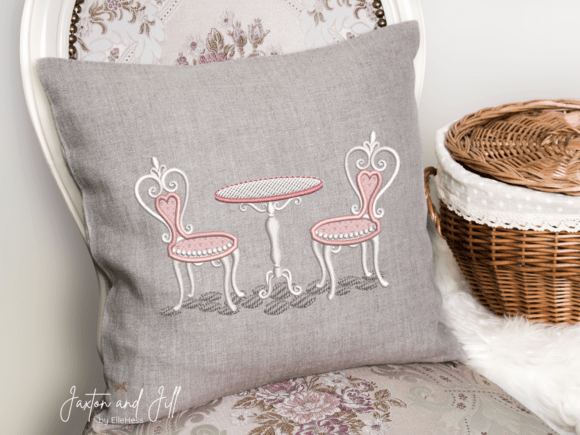
First glance at the Café Table and Chairs Embroidery? It’s quietly confident—not flashy, not fussy. Two delicate heart-back chairs flank a dainty round table, all rendered in clean lines and gentle curves. This isn’t a bold food-themed graphic like a coffee cup or croissant; it’s a vignette—intimate, nostalgic, and full of implied story. As a designer who’s stitched hundreds of food-adjacent embroidery files, I immediately sensed its sweet spot: handmade products where charm matters more than impact. Think linen tea towels for a local café, baby onesies for a baker’s newborn, or a minimalist tote bag for a boutique selling artisanal preserves.
Where It Lives Best—And Why
I tested Café Table and Chairs Embroidery on a midweight cotton twill tote bag—no lining, no interfacing—and it landed perfectly. The design’s open layout breathes across the fabric. The chairs’ slender legs and the table’s subtle rim read clearly without overcrowding. On apparel, it shines on relaxed-fit sweatshirts (left chest placement) and aprons (pocket corner), especially when paired with soft, matte thread colors like heather gray, oatmeal, and dusty rose. For Etsy sellers, this is a quiet brand-builder: customers don’t just buy a stitched image—they buy a mood, a pause, a slice of slow living.
It also works beautifully as an embroidered patch—stitched onto denim jackets or canvas book covers—because the heart-back motif reads well even at 3.5 inches wide. As holiday embroidery, it adds warmth to kitchen towels gifted alongside homemade jam. And for nursery decor? A single chair stitched onto a muslin wall hanging feels intentional, not cutesy. Its Food category ties are gentle: it evokes cafés, breakfast nooks, and shared moments—not ingredients or recipes—so it avoids seasonal or trend-driven limitations.
Where Caution Is Warranted
This isn’t a design that forgives shortcuts. On thin fabrics like voile or lightweight rayon, the satin stitch outlining the chairs’ hearts can pucker if stabilizer isn’t layered thoughtfully—light tear-away alone won’t cut it. I recommend medium-weight cutaway + light tear-away for anything under 5 oz/yd². On stretchy knits (think baby bodysuits or lounge tees), skip direct hooping—use adhesive stabilizer and baste first. The fine lines connecting table legs to the base demand steady tension; on curved surfaces like caps, test placement with a mock hoop before committing.
Dark fabric demands attention too. The design relies on shape and contour over heavy fill—so on navy or charcoal, avoid low-contrast thread (e.g., black-on-black). Instead, choose ecru or pale sage for definition. And while it’s labeled an applique design, I found the inner table detail works best as a fill-stitch element, not raw-edge appliqué—especially for washable finished products like tea towels or kids’ items. Overly dense stitching in the chair backs could stiffen lightweight fabrics, so review stitch density before scaling up.
What It Adds to Your Finished Product
Café Table and Chairs Embroidery elevates perceived value without shouting “premium.” Customers notice the care in the curve of each heart-back, the balance between negative space and detail. That translates directly to trust—especially for small shop owners and craft fair vendors. When buyers see this on a handmade pillow cover or personalized gift, they sense intentionality, not automation. It supports brand consistency for makers who lean into calm, thoughtful aesthetics—think ceramic studios, botanical apothecaries, or slow-fashion labels.
For digital product sellers, it’s a versatile asset: use it in printable mockups showing lifestyle context (a folded towel beside a ceramic mug), or layer it subtly into branding elements like packaging stamps or thank-you cards. Just remember—it’s not a standalone logo. Its strength lies in complementing, not commanding.
Practical Designer Notes Before You Stitch
- Always test first—run Café Table and Chairs Embroidery on scrap fabric matching your final project’s weight, weave, and stretch.
- Check thread color contrast in natural light—not just on screen. What looks distinct on your monitor may vanish on oat-colored linen.
- Review stitch density in your embroidery software. If fills feel overly tight, reduce density by 5–8% for breathable results on apparel.
- Confirm hoop size compatibility. The design’s width fits standard 4×4 hoops, but check whether the height pushes limits—especially if you plan to add monogramming nearby.
- Inspect small details at 200% zoom: the join between table top and leg should be smooth, not jagged. If corners look pixelated, the file may need cleaning.
- Test black-and-white mockups to gauge silhouette strength—this design lives or dies by its outline clarity.
- Compare light vs. dark backgrounds using physical swatches, not just digital previews.
- Use proper stabilizer—not just “what’s on hand.” Medium cutaway is safest for most applications.
- Verify licensing before selling finished items or bundling Café Table and Chairs Embroidery into digital embroidery kits. Commercial use rights aren’t implied.
The Bottom Line for Makers
Café Table and Chairs Embroidery isn’t for every project—but when it’s right, it’s quietly unforgettable. It suits designers who understand that elegance in embroidery often lives in restraint: in the space between chairs, the curve of a heart, the quiet dignity of a round table waiting. Use it where handmade presentation matters, where customers value subtlety over saturation, and where your craft business tells a story slower than the scroll. Stitch it with care, pair it with intention, and let it do what it does best: invite people to sit down, breathe, and stay awhile.